
Buddhism
Buddhism is the world's fourth-largest religion with over 520 million followers, or
over 7% of the global population, known as Buddhists. Buddhism encompasses a variety
of traditions, beliefs, and spiritual practices largely
based on original teachings attributed to the Buddha and
resulting interpreted philosophies. It originated in ancient India as
a Samara tradition sometime between the 6th and 4th centuries BCE,
spreading through much of Asia. Two major extant branches of Buddhism are
generally recognized by scholars: Theravada (Paly: "The School
of the Elders") and Mahayana (Sanskrit: "The Great
Vehicle").
Most Buddhist traditions share the goal of overcoming suffering and
the cycle of death and rebirth, either by the attainment of Nirvana or
through the path of Buddha-hood. Buddhist schools vary in their interpretation of
the path to liberation, the relative importance, and canonicity assigned to
the various Buddhist texts, and their specific teachings and practices. Widely observed practices
include taking refuge in the Buddha, the Dharma and
the Shanghai, observance of moral precepts, monasticism, meditation,
and the cultivation of the Parameters (perfections, or virtues).
Theravada Buddhism has a widespread following in Sri Lanka and Southeast
Asia such as Cambodia, Laos, Myanmar, and Thailand.
Mahayana, which includes the traditions of Pure Land, Zen, Niching
Buddhism, Shinbone, and Tainted (Tindal) is found
throughout East Asia.
Vajrayana, a body of teachings attributed to Indian adepts,
may be viewed as a separate branch or as an aspect of Mahayana Buddhism. Tibetan Buddhism, which preserves the
Vajrayana teachings of eighth-century India are practiced in the countries of
the Himalayan region, Mongolia, and Kalmyk a.


Life of the Buddha -
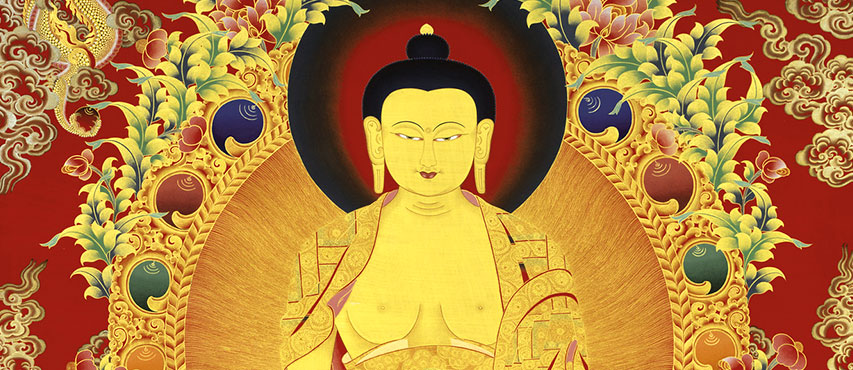
Buddhism is an Indian religion founded on the teachings of
a mendicant and spiritual teacher called "the Buddha" ("the
Awakened One", c. 5th to 4th century BCE). Early texts have the Buddha's
family name as "Gautama" (Paly: Go tama). The details of Buddha's
life are mentioned in many Early Buddhist Texts but are inconsistent,
and his social background and life details are difficult to prove, the precise
dates are uncertain.
The evidence of the early texts suggests that Siddharta
Gautama was born in Lambing and grew up in Kapilavastu, a town in the Ganges Plain, near
the modern Nepal–India border, and that he spent his life in what is now
modern Bihar and Uttar Pradesh. Some hagiographic legends
state that his father was a king named Suddhodana, his mother was Queen Maya,
and he was born in Lambing. However, scholars such as Richard Gombrich consider
this a dubious claim because a combination of evidence suggests he was born in
the Shaky a community, which was governed by a small oligarchy
or republic-like council where there were no ranks but where seniority
mattered instead. Some of the stories about Buddha, his life, his teachings,
and claims about the society he grew up in may have been invented and
interpolated at a later time into the Buddhist texts.
According to early texts such as the Pali Ariyapariyesanā-sutta ("The discourse on the a noble quest," MN 26) and its Chinese parallel at MĀ 204, Gautama was moved by the
suffering (dukkha) of life and death, and its endless repetition due
to rebirth. He thus set out on a quest to find liberation from
suffering (also known as "nirvana"). Early texts and biographies
state that Gautama first studied under two teachers of meditation, namely Alara
Kalama (Sanskrit: Arada Kalama) and Uddaka Ramaputta (Sanskrit:
Udraka Ramaputra), learning meditation and philosophy, particularly the
meditative attainment of "the sphere of nothingness" from the former,
and "the sphere of neither perception nor non-perception" from the
latter.


Finding these teachings to be insufficient to attain his goal, he turned to the practice of severe asceticism, which included a strict fasting regime and various forms of breath control. This too fell short of attaining his goal, and then he turned to the meditative practice of dhyana. He famously sat in meditation under a Ficus religiosa tree now called the Bodhi Tree in the town of Bodh Gaya and attained "Awakening" (Bodhi).
According to various early texts like the Mahāsaccaka-sutta, and the Samaññaphala
Sutta, on awakening, the Buddha gained insight into the workings of
karma and his former lives, as well as achieving the ending of the mental
defilements (asavas), the ending of suffering, and the end of rebirth
in saṃsāra. This event also brought certainty about the Middle
Way as the right path of spiritual practice to end suffering. As a fully enlightened Buddha,
he attracted followers and founded a Sangha (monastic order). He spent the rest of his life
teaching the Dharma he had discovered, and then died, achieving
"final nirvana," at the age of 80 in Kushinagar, India.
Buddha's teachings were propagated by his followers, which in
the last centuries of the 1st millennium BCE became various Buddhist
schools of thought, each with its own basket of texts containing
different interpretations and authentic teachings of the Buddha; these over time evolved into many
traditions of which the more well-known and widespread in the modern era
are Theravada, Mahayana, and Vajrayana Buddhism.
Worldview
The Four Truths express the basic orientation of Buddhism:
we crave and cling to impermanent states and things, which
is dukkha, "incapable of satisfying" and painful. This
keeps us caught in samsara, the endless cycle of repeated rebirth,
dukkha, and dying again. But there is a way to liberation from
this endless cycle to the state of nirvana, namely following the Noble
Eightfold Path.
The truth of dukkha is the basic insight that
life in this mundane world, with its clinging and craving to impermanent
states and things, is dukkha, and unsatisfactory. Dukkha can be
translated as "incapable of satisfying," "the unsatisfactory nature
and the general insecurity of all conditioned phenomena"; or
"painful." Dukkha is most commonly translated as
"suffering," but this is inaccurate since it refers not to episodic
suffering, but to the intrinsically unsatisfactory nature of temporary states
and things, including pleasant but temporary experiences. We expect happiness from states
and things that are impermanent, and therefore cannot attain real happiness.
In Buddhism, dukkha is one of the three marks of existence,
along with impermanence and anattā (non-self). Buddhism, like other major
Indian religions, asserts that everything is impermanent (anicca), but, unlike
them, also asserts that there is no permanent self or soul in living beings (anattā). The ignorance or misperception
(avijjā) that anything is permanent or that there is self in any being
is considered a wrong understanding, and the primary source of clinging and
dukkha.
Dukkha arises when we crave (Pali: Tanah) and
cling to these changing phenomena. The clinging and craving produce karma,
which ties us to samsara, the round of death and rebirth. Craving
includes kama-tanha, craving for sense-pleasures; bhava-tanha,
craving to continue the cycle of life and death, including rebirth; and vibhava-tanha,
craving to not experience the world and painful feelings.
Dukkha ceases or can be confined when craving and clinging cease or
are confined. This also means that no more karma is being produced, and rebirth
ends. Cessation is nirvana, "blowing out,"
and peace of mind.
By following the Buddhist path to moksha, liberation, one starts to disengage from craving
and clinging to impermanent states and things. The term "path" is
usually taken to mean the Noble Eightfold Path, but other versions of
"the path" can also be found in the Nikayas. The Theravada tradition regards
insight into the four truths as liberating in itself.


The cycle of rebirth -
Saṃsāra
Saṃsāra means "wandering" or "world", with the
connotation of cyclic, circuitous change. It refers to the theory of
rebirth and "cyclicality of all life, matter, and existence", a fundamental assumption of Buddhism, as with all major Indian religions. Samsara in Buddhism is
considered to be dukkha, unsatisfactory and painful, perpetuated by desire and avidya
(ignorance), and the resulting karma.
The theory of rebirths, and realms in which these rebirths can
occur, is extensively developed in Buddhism, in particular, Tibetan Buddhism
with its wheel of existence (Bhavacakra) doctrine. Liberation from this cycle of
existence, nirvana, has been the foundation and the most important
historical justification of Buddhism.
The later Buddhist texts assert that rebirth can occur in six
realms of existence, namely three good realms (heavenly, demi-god, human) and
three evil realms (animal, hungry ghosts, hellish). Samsara ends if a person
attains nirvana, the "blowing out" of the desires and the
gaining of true insight into impermanence and non-self reality.
Rebirth
Rebirth refers to a process whereby beings go through a
succession of lifetimes as one of many possible forms of sentient life,
each running from conception to death. In Buddhist thought, this rebirth does not involve any
soul, because of its doctrine of anattā (Sanskrit: anātman, no-self doctrine) which rejects the
concepts of a permanent self or an unchanging, eternal soul, as it is called
in Hinduism and Christianity. According to Buddhism there
ultimately is no such thing as a self in any being or any essence in anything.
The Buddhist traditions have traditionally disagreed on what it
is in a person that is reborn, as well as how quickly the rebirth occurs after
each death. Some Buddhist traditions assert that "no-self"
doctrine means that there is no perduring self, but there is Avaya (inexpressible) the self which migrates from one life to another. The majority of Buddhist
traditions, in contrast, assert that vijñāna (a person's consciousness)
though evolving, exists as a continuum and is the mechanistic basis of what
undergoes rebirth, rebecoming, and redeath. The rebirth depends on
the merit or demerit gained by one's karma, as well as that accrued
on one's behalf by a family member.
Each rebirth takes place within one of five realms according to
Theravadins, or six according to other schools – heavenly, demi-gods, humans,
animals, hungry ghosts, and hellish.
In East Asian and Tibetan Buddhism, rebirth is not instantaneous,
and there is an intermediate state (Tibetan "bardo") between one
life and the next. The orthodox Theravada position rejects the wait and
asserts that the rebirth of a being is immediate. However, there are passages in
the Samyutta Nikaya of the Pali Canon that seem to lend support to
the idea that the Buddha taught about an intermediate stage between one life
and the next.

Karma -
In Buddhism, karma (from Sanskrit: "action,
work") drives samsara – the endless cycle of suffering
and rebirth for each being. Good, skillful deeds (Pāli: kusala) and bad, unskillful deeds (Pāli: akusala) produce "seeds" in the
unconscious receptacle (ālaya) that mature later either in this life or in a subsequent rebirth. The existence of karma is a
core belief in Buddhism, as with all major Indian religions, it implies neither
fatalism nor that everything that happens to a person is caused by karma.
A central aspect of the Buddhist theory of karma is that intent (catena)
matters and is essential to bring about a consequence or phala "fruit"
or vipāka "result". However, good or bad karma
accumulates even if there is no physical action, and just having ill or good
thoughts creates karmic seeds; thus, actions of body, speech, or mind all lead
to karmic seeds. In the Buddhist traditions, life aspects affected by the
law of karma in past and current births of a being include the form of rebirth, the realm of rebirth, social class, character, and major circumstances of a
lifetime. It operates like the laws of physics, without external
intervention, on every being in all six realms of existence including
human beings and gods.
A notable aspect of the karma theory in Buddhism is merit transfer. A person accumulates merit not only through intentions and ethical living, but also is able to gain merit from others by exchanging goods and services, such as through Dana (charity to monks or nuns). Further, a person can transfer one's own good karma to living family members and ancestors.
The third "jewel" which Buddhists take refuge in is the "Sangha", which refers to the monastic community of monks and nuns who follow Gautama Buddha's monastic discipline which was "designed to shape the Sangha as an ideal community, with the optimum conditions for spiritual growth." The Sangha consists of those who have chosen to follow the Buddha's ideal way of life, which is one of celibate monastic renunciation with minimal material possessions (such as an alms bowl and robes).Sangha -
The Sangha is seen as important
because they preserve and pass down Buddha Dharma. As Gethin states "the
Sangha lives the teaching, preserves the teaching as Scriptures, and teaches the
wider community. Without the Sangha, there is no Buddhism."
The Sangha also act as a "field
of merit" for laypersons, allowing them to make spiritual merit or goodness
by donating to the Sangha and supporting them. In return, they keep their duty
to preserve and spread the Dharma everywhere for the good of the world.
The Sangha is also supposed to follow the Vinaya (monastic rule) of the Buddha, thereby serving as a spiritual example for the world and future generations. The Vinaya rules also force the Sangha to live in dependence on the rest of the lay community (they must beg for food etc) and thus draw the Sangha into a relationship with the lay community.
